SUSTAINABLE GROWTH STARTS WITH INSIGHT
23 sep. 2026Pan Oston improves CO₂ efficiency by 35%
Sustainability is an integral part of Pan Oston’s long-term strategy. It is one of the core values set out in our corporate goals for 2030 and is a key driver of the way we develop and manufacture products and collaborate with customers.
Our approach to sustainability is based on three pillars. Firstly, we create value for customers by contributing to their sustainability objectives. Secondly, we work systematically to reduce the CO₂ impact of our products and activities. Finally, we invest in improving the quality and reliability of our emissions data, so that we can make informed choices and monitor our progress transparently. We firmly believe that sustainability only has a real impact when environmental benefits go hand in hand with demonstrable added value, such as cost savings and more efficient processes.
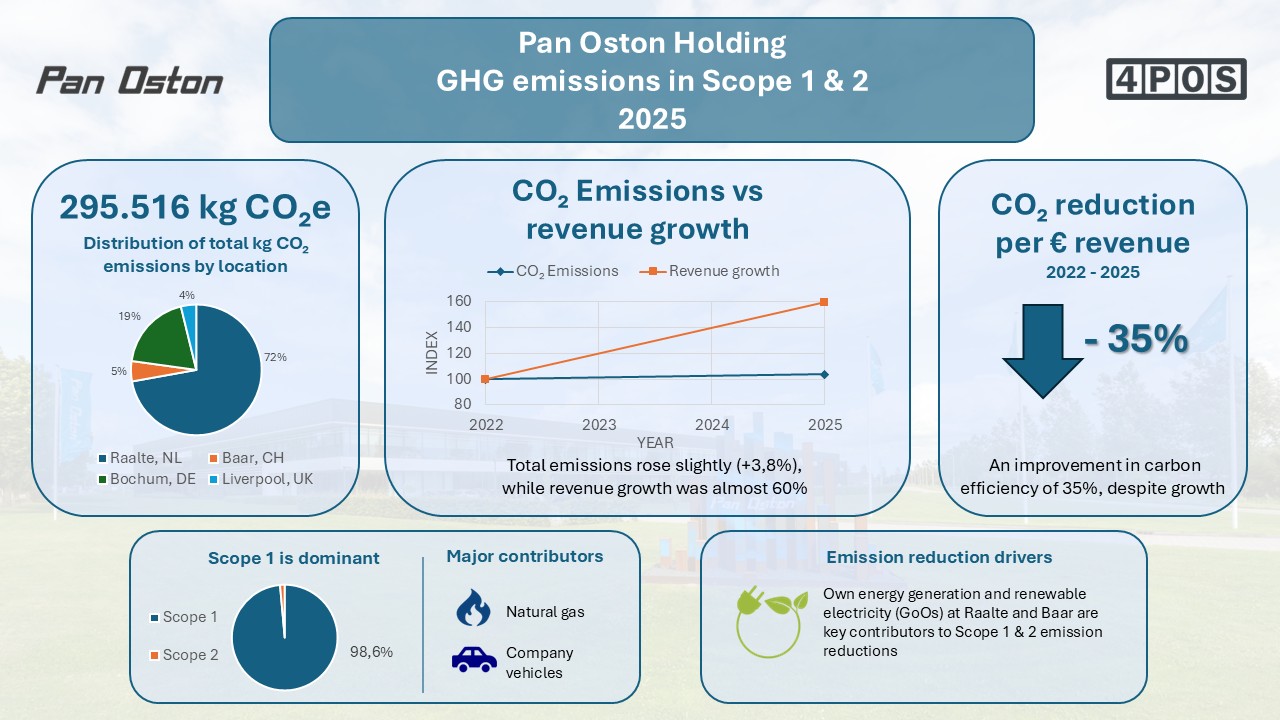
To establish a solid baseline, Pan Oston commissioned an initial emissions assessment of its own emissions in 2022. This baseline measurement focused on Scope 1 and Scope 2 emissions: emissions arising from sources under the direct control of Pan Oston Holding, such as gas consumption, company vehicles and purchased electricity.
This survey was carried out again in 2025. The results not only provide insight into our current impact, but also show the progress we have made.
Total Scope 1 and Scope 2 emissions in 2025 amounted to 295.5 tonnes of CO₂ equivalent. This represents a 3.8 per cent increase compared with the baseline measurement in 2022. However, on its own, this figure tells only part of the story. Over the same period, Pan Oston’s turnover grew by almost 60 per cent.
When emissions are set against turnover, a much more relevant picture of sustainability performance emerges. CO₂ emissions per euro of turnover fell by approximately 35 per cent. This means that Pan Oston has become significantly more efficient in creating economic value relative to the associated CO₂ emissions.
The results are also evident in day-to-day operations. Thanks to investments in solar panels, electricity consumption from the grid at our site in Raalte fell by nearly 200,000 kWh. In addition, gas consumption was reduced by nearly 10,000 m³. These improvements contribute directly to a lower environmental impact and more efficient energy use.
For Pan Oston, these results confirm that sustainable growth and commercial growth can go hand in hand. By continuously investing in data, innovation and energy efficiency, we are continuing to work towards our ambition to reduce our environmental footprint whilst creating value for customers. Together, we are building future-proof retail environments in which sustainability is a natural part of good business practice.
.jpg)
.jpg)